
Quick answer: If you don’t already own a tool battery system, the EGO CS1611 comes with a battery and charger and has a tool-free chain adjuster [3]. If you own Milwaukee M18 or DeWalt FLEXVOLT batteries, buy that brand’s bare saw [4][5]. Before you start, read OSHA’s chainsaw safety rules below [2].
At a glance
- Helene timber damage, N.C.
- About 822,000 acres, an estimated $214 million [1]
- Who owns the damaged land
- 78% private, 21% public, 1% parks and reserves [1]
- Comparable storms
- Most damaging wind event since Fran (1996) and Hugo (1989) [1]
- OSHA PPE list
- Hard hat, hearing and eye protection, boots, chaps or work pants, gloves [2]
- Recall to know about
- Milwaukee M18 FUEL top-handle saw (2826-20), not a pick here [7]
Why North Carolina homeowners need one
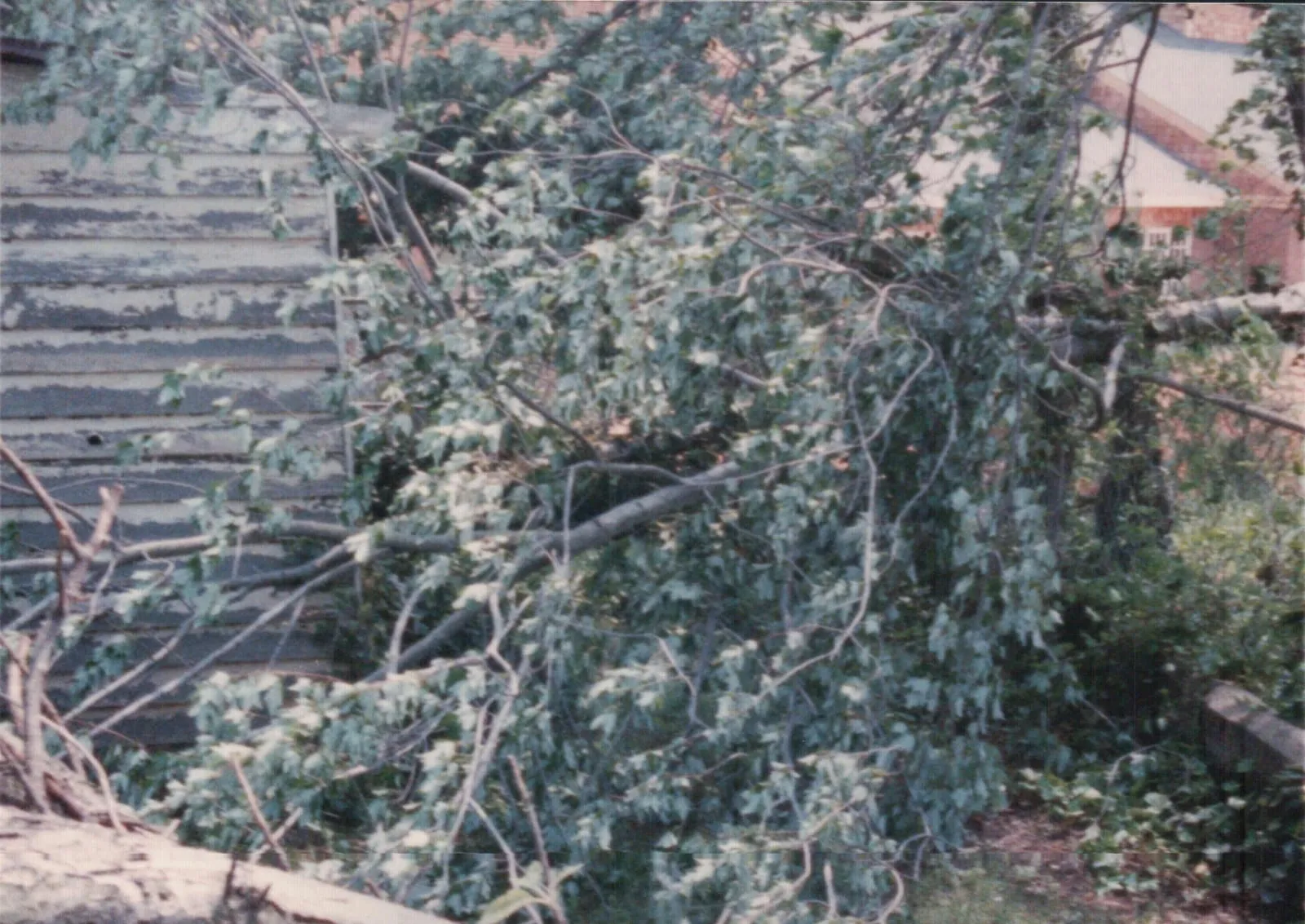
Hurricane Helene flattened trees across western North Carolina. The N.C. Forest Service’s aerial appraisal estimated that about 822,000 acres of timberland were damaged, worth about $214 million, and called it possibly the most damaging wind event in the state since Hurricane Fran in 1996 in the east and Hurricane Hugo in 1989 in the west [1]. About 78% of the damage was on private land [1], which means homeowners and small landowners are doing much of the cleanup themselves.
A battery chainsaw makes sense for that work: there’s no fuel to mix or store, and the same batteries often run a leaf blower, light or fan.
How we chose
- Specs from the maker. Bar length, battery and runtime claims come from each maker’s product page.
- Kickback protection. OSHA tells chainsaw users to be prepared for kickback and to use saws with features that reduce it, such as chain brakes and low-kickback chains [2]. We note what each maker lists.
- Major battery platforms. EGO, Milwaukee and DeWalt batteries are widely sold, and the same batteries run other storm tools.
- Recall check. We searched the CPSC recall database for each brand and model on November 2, 2026. None of our picks has been recalled. Milwaukee recalled its M18 FUEL top-handle chainsaw (catalog 2826-20) for a laceration hazard [7]; that is a different saw from the two Milwaukee models below.
Our picks
Best for: First-time buyers who need battery and charger
EGO Power+ 16 in. Chain Saw Kit (CS1611)
It comes ready to use with a 2.5Ah battery and charger, and the chain tension adjusts without tools, which helps when you're new to chainsaws.
- 16 in. bar and chain; 20 m/s chain speed [3]
- Up to 130 cuts on a 4x4 with the 2.5Ah battery [3]
- Kickback brake with position indicator; automatic oiling; tool-free tensioning [3]
- IPX4 weather resistance; 5-year tool and 3-year battery limited warranty [3]
Safety check: EGO's page doesn't list a safety certification; OSHA says electric chainsaws should be certified by a nationally recognized testing lab, so check the label [2]. No CPSC recall found for the CS1611 (checked 2026-11-02).
Watch out: The included 2.5Ah battery is small for a day of cleanup. Count on buying a second, larger battery.
See it on Amazon → We chose it from specs and safety records; we haven't tested it ourselves.
Best for: Milwaukee M18 households cutting larger limbs
Milwaukee M18 FUEL 16 in. Chainsaw (2727-20)
Milwaukee publishes cut counts by log size, which makes it easier to plan a cleanup day, and says the saw cuts faster than gas.
- 16 in. Oregon bar and chain; also takes a 14 in. bar [4]
- With an HD12.0 battery: about 120 cuts in 6 in. logs, 40 in 10 in. logs, 20 in 14 in. logs [4]
- Milwaukee compares it to a gas engine up to 40cc [4]
- 3-year warranty [4]
Safety check: Milwaukee's page doesn't list a safety certification; check the label for an NRTL mark [2]. No CPSC recall found for the 2727-20 (checked 2026-11-02).
Watch out: Tool only; the battery Milwaukee recommends (HD12.0 or XC8.0) is sold separately and costs a lot if you don't already own one. Milwaukee's page doesn't list a chain brake or weight.
See it on Amazon → We chose it from specs and safety records; we haven't tested it ourselves.
Best for: DeWalt FLEXVOLT households and the biggest cuts
DeWalt 60V MAX 18 in. Brushless Chainsaw (DCCS672B)
The longest bar here, with a low-kickback bar and chain plus a chain brake, both of which OSHA recommends [2].
- 18 in. bar; 2.85 peak horsepower with a DCB609 FLEXVOLT battery [5]
- Low-kickback bar and chain; chain brake [5]
- Brushless motor; automatic oiling; tooled chain tensioning [5]
- 3-year limited warranty, 1 year free service [5]
Safety check: DeWalt's page doesn't list a safety certification; check the label for an NRTL mark [2]. No CPSC recall found for the DCCS672 (checked 2026-11-02).
Watch out: Tool only, and the power rating assumes DeWalt's large 60V FLEXVOLT battery. Chain tension needs the included tool rather than a knob.
See it on Amazon → We chose it from specs and safety records; we haven't tested it ourselves.
Best for: Clearing small limbs and brush
Milwaukee M18 FUEL HATCHET 8 in. Pruning Saw (3004-20)
For branches and brush, a small saw is easier to control than a full-size chainsaw, and this one weighs less than 5 lb without a battery [6].
- 8 in. bar and chain; also takes a 6 in. bar [6]
- Under 5 lb without a battery [6]
- Milwaukee says it cuts faster than 25cc gas [6]
- Metal bucking spikes; variable-speed trigger [6]
Safety check: Milwaukee's page doesn't list a safety certification; check the label for an NRTL mark [2]. No CPSC recall found for the 3004-20 (checked 2026-11-02).
Watch out: Not for trunks or large limbs. Its light weight makes one-handed use tempting; OSHA says to keep both hands on the handles [2]. Battery sold separately.
See it on Amazon → We chose it from specs and safety records; we haven't tested it ourselves.
Buying guide
- Stay in one battery family. A bare saw is much cheaper if you already own that brand’s batteries.
- Bar length isn’t everything. A 16 in. bar handles most limbs around a house. Longer bars are heavier and harder to control.
- Buy spare chain and bar oil. A dull chain cuts slowly. OSHA says to clear dirt and debris from the saw’s path and look for nails and metal before cutting [2].
- Know when to call a pro. OSHA lists trees with a heavy lean, trees on unstable ground or steep slopes, and cutting above shoulder height as higher-risk work [2].
Sources
- N.C. Forest Service: Forest Damage Appraisal, Hurricane Helene (Oct. 22, 2024)
- OSHA: Working Safely with Chainsaws (fact sheet)
- EGO: POWER+ 16 in. Chain Saw (CS1611)
- Milwaukee Tool: M18 FUEL 16 in. Chainsaw (2727-20)
- DeWalt: 60V MAX Brushless Cordless 18 in. Chainsaw, Tool Only (DCCS672B)
- Milwaukee Tool: M18 FUEL HATCHET 8 in. Pruning Saw (3004-20)
- CPSC: Milwaukee Tool Recalls M18 FUEL 14 in. and 12 in. Top Handle Chainsaws Due to Laceration Hazard
Common questions
Is a cordless chainsaw strong enough for storm cleanup?
For limbs and small trees, yes. EGO and Milwaukee compare their 16 in. saws to roughly 40cc gas saws, and DeWalt compares its 18 in. saw to a 40.9cc gas model. Large trunks, trees under heavy tension and anything near power lines are jobs for a professional.
What safety gear do I need to run a chainsaw?
OSHA's chainsaw fact sheet lists head protection, hearing protection, eye and face protection, protective footwear, leg protection such as chaps or work pants, and work gloves.
Should I cut a tree that's on a power line?
No. OSHA tells chainsaw users to identify electrical lines in and near the work area before starting. Report a tree on a line to your utility and keep away from it.